Hagia Sophia: An Illustrated Story

Hagia Sophia: An Illustrated Story

An account of Hagia Sophia, in the testimony of documents and images

Look closer

Four ways to examine Hagia Sophia

Cornelius Loos's drawing of the dome of Hagia Sophia: the ring of windows at its base, the pendentives and the carrying arches.
01 · Architecture

No precedent before it, no easy equal after

The present building is the third church on this site, raised between 532 and 537 to the design of Anthemius of Tralles and Isidore of Miletus. For the first time at this scale, a dome was set not on a circular wall but on a square plan, carried by pendentives. A ring of forty windows encircles its base, some 31 metres across; the book looks past the dome to the arches and half-domes that hold it up.

Link to this section: No precedent before it, no easy equal after
Christ in the Deësis mosaic: gold ground, cruciform halo, blessing hand and jewelled Gospel book.
02 · Art

The mosaics are famous; what surrounds them seldom gets a turn

The gold-ground mosaics are the best known face of the building. Around them stand marble panels opened and matched like the pages of a book, capitals cut deep with the drill, bronze door leaves and eight vast calligraphic roundels. Any one of them alone would be enough to make this building famous the world over.

Link to this section: The mosaics are famous; what surrounds them seldom gets a turn
The roof of Hagia Sophia: the lead-covered dome, the row of windows at its base, and Sedat Bornovalı standing before it.
03 · What a single glance cannot take in

The ground you walk is one slice of fifteen centuries

Hagia Sophia is a place of visit and of worship, and the route almost everyone takes is the same. The roof at the foot of the dome, the stone ramps that climb to the upper gallery, the names and marks cut into the parapets across the centuries, among them Norse runes: none of it lies on that route. The book leaves the route.

Link to this section: The ground you walk is one slice of fifteen centuries
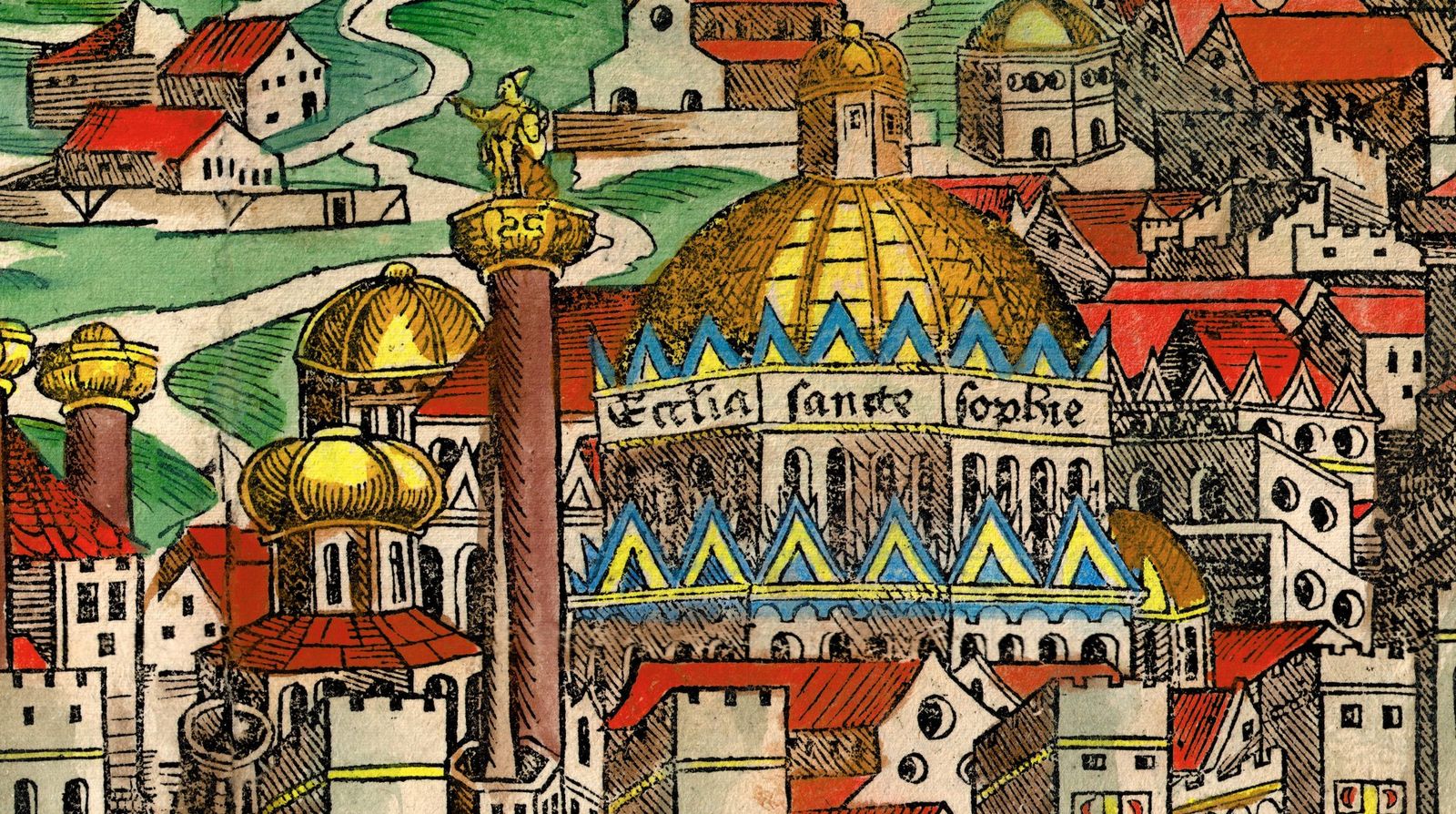
A hand-coloured woodcut of Constantinople; at its centre Hagia Sophia, «Ecclia sancte Sophie» lettered above the dome.
04 · Historical documents

Archives bring to light what time erased or covered over

Inscriptions, travellers' engravings and written accounts, early photographs: each is a first-hand witness of the century that saw the building. Some of the mosaics uncovered and then covered again during the Fossati restoration of 1847-1849 survive only in the drawings made at the time. The book rests every claim on such documents.

Link to this section: Archives bring to light what time erased or covered over
05 · Into the mosaic

The Deësis mosaic

Fifth stop: move from the setting to the mosaic panel, then to the details of the face and of the hand.

01 / 04

The setting

The south gallery: the mosaic in its own place on the wall, ringed by vaults and windows. Whichever corner of this space you turn to, another work appears.

Link to this section: The setting
02 / 04

Mosaic panels

This panel is a Deësis, a scene of intercession. Perhaps one of the most famous compositions in Byzantine art; only its upper portion survives.

Link to this section: Mosaic panels
03 / 04

Details

From a distance it reads as a single gold surface. Only at this range do the face, the halo and the modelling separate; the details that draw you further in begin here.

Link to this section: Details
04 / 04

Finer details

The blessing hand. Within a single hand, skin, shadow and contour are built from stones of different colours; the detail runs down to the individual tesserae.

Link to this section: Finer details
The scope of the book

Hagia Sophia’s architecture, works of art and historical sources.

Architecture and detail

It examines the dome, galleries, doors, mosaics and inscriptions in their architectural setting.

Sources and observation

It compares historical documents with observations of the building.

The history of Istanbul

It places Hagia Sophia within Istanbul’s urban and cultural history.

Dome, marble, mosaic and inscription: evidence of different periods in one building.

Inside the book

Built on documents and images

The Turkish original, Ayasofya: Tarihin En Uzun Şiiri (Timaş Yayınları, 2020; 2nd edition 2022, 240 pages), examines Hagia Sophia through historical documents, drawings and photographs. An English edition is in preparation.

About the book
With gratitude

Contributors to the research and images in the book.

Acknowledgements
Get the book

Hagia Sophia: An Illustrated Story

An English edition is in preparation. In the meantime, the Turkish edition — Ayasofya: Tarihin En Uzun Şiiri — is available now.

Turkish edition →